Home · 6 min read · 25/09/2026
Dyson Cordless Vacuums Compared: Which Model Fits Your Home
From the V8 Cyclone to the V16 Piston Animal: where today's Dyson cordless vacuums actually differ and when a smaller or older model is perfectly adequate.
Ad: links to partner shops are affiliate links. If you buy through them we receive a commission; your price stays the same. Prices are snapshots; the price in the shop is binding.
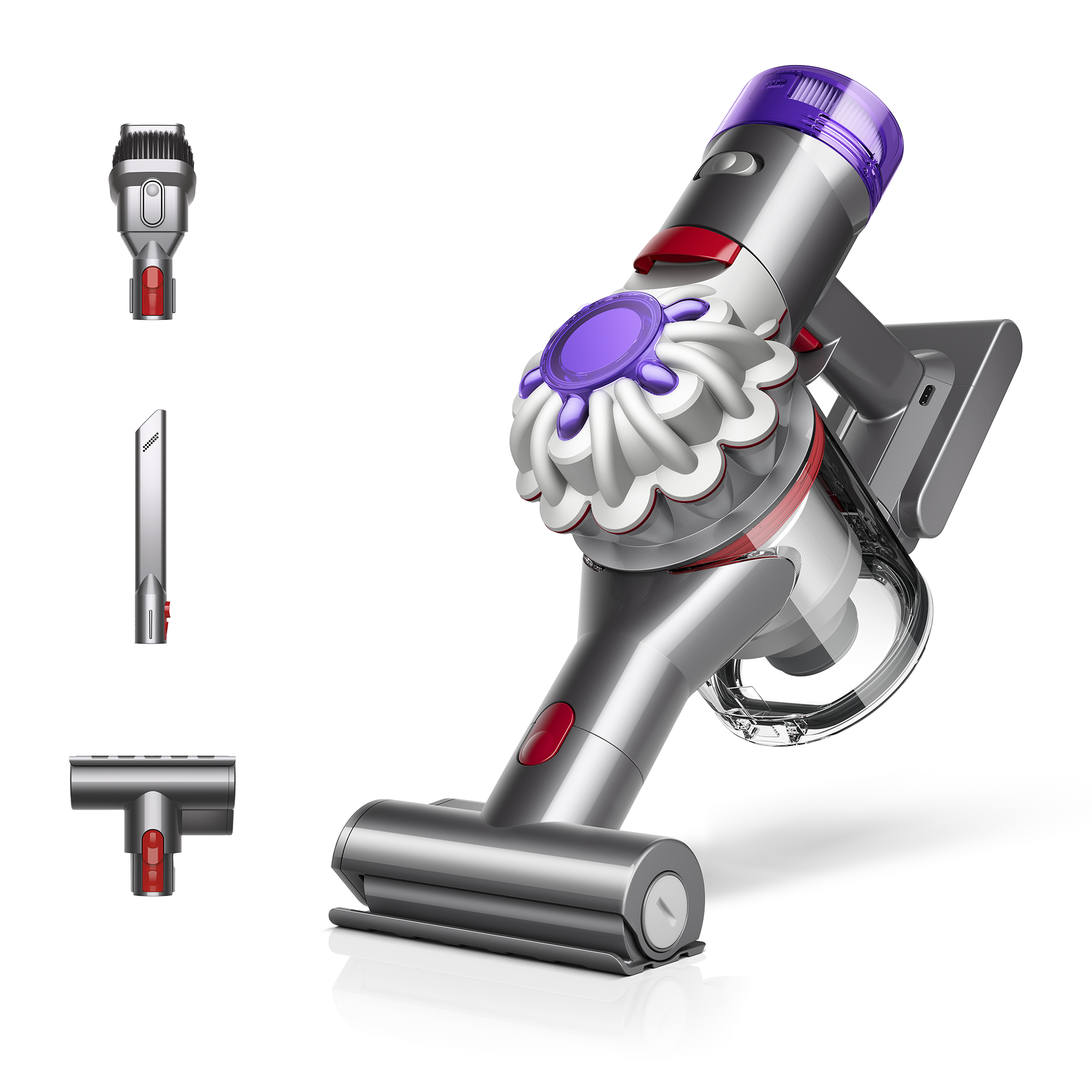
Dyson currently has roughly half a dozen cordless vacuum lines in its range, and the model names hardly help with the choice. This guide classifies the models that are current as of September 2026 based on manufacturer specifications and their design, and shows which differences actually matter in everyday use.
The current models at a glance
- V8 Cyclone: 150 AW, up to 60 minutes, around 2.7 kg, 0.54 l bin. The entry-level model, without display, without light and without auto mode.
- V10 Konical: 150 AW, up to 60 minutes, around 2.7 kg, 0.54 l bin. Floor head with two conical rollers against tangled hair, green light beam, optionally with emptying station.
- V12 Detect Slim: 150 AW, up to 60 minutes, 2.2 kg, 0.35 l bin. Lightweight, with laser floor head, particle sensor and display.
- V15 Detect: 240 AW, up to 60 minutes, just over 3 kg, 0.76 l bin. Laser, particle sensor, display with particle count.
- Gen5detect: 280 AW, up to 70 minutes, 3.5 kg, 0.77 l bin. HEPA filtration, crevice tool integrated into the suction tube. Increasingly harder to find in stores.
- V16 Piston Animal: 315 AW, up to 70 minutes, around 3.4 to 3.5 kg according to test reports, roughly 1.3 l bin that compresses dust. The current top model.
- PencilVac: around 4 cm thin, 1.8 kg, up to 30 minutes, 0.08 l bin. Only intended for hard floors.
Plus Submarine variants (V12s Detect Slim, V15s Detect, V16 Piston Animal), which add an extra wet roller for hard floors.
Runtime: The maximum specification is the eco value
The 60 or 70 minutes apply to the lowest setting. In boost mode, test reports measure around a quarter hour for the V16, and just over eight minutes for the V8 Cyclone. For a home with three rooms, the eco runtime is almost always enough, but anyone vacuuming lots of carpet at higher settings hits the limit faster.
Good to know: On the V12, V15, Gen5detect and V16, the battery can be swapped with a click. A second battery doubles the runtime and later replaces a worn battery without needing a new machine. For other models, it's worth checking the datasheet before buying to see if the battery is replaceable.
Suction power: When more air watts actually make a difference
Air Watt (AW) is Dyson's preferred measurement. It cannot be directly compared with the pascal figures from many other manufacturers, but within the Dyson range it can be. 150 AW is sufficient for hard floors and low-pile carpet. The extra power of the V15, Gen5detect and V16 really pays off on high-pile carpet, with deeply embedded dirt and with pet hair in the carpet.
Sensors and laser: Convenient, but not essential
- Dust illumination: A flat laser or light beam on the floor head makes fine dust on smooth floors visible. On carpet it does little.
- Particle sensor: V12, V15 and Gen5detect count the particles being sucked in and adjust power in auto mode. This saves battery because it only boosts when needed.
- Floor detection: The new floor head on the V16 recognizes the floor type and adjusts suction power and roller speed automatically.
To be honest, these are comfort features. The floor gets clean without them, you just see less precisely where dust remains.
Operation, bin and accessories
Button instead of trigger: On the V15 Detect you have to keep the trigger pressed while vacuuming. Gen5detect, V16, V10 Konical and V8 Cyclone have an on/off switch. Anyone vacuuming for long stretches notices the difference in hand strain.
Bin: The 0.35 l of the V12 fills quickly, the 0.08 l of the PencilVac is only enough for brief use. The V16 compresses the contents so you empty it less often and don't have to pull hair out by hand. For the V10 Konical and V8 Cyclone there is the Auto-empty Dock: it empties the bin into a sealed 2.5-litre bag that Dyson says lasts up to 60 days.
Accessories: The packages vary significantly, such as standard, extended cleaning set or submarine. Compare the actual contents, not just the model name.
Weaknesses you should know about
- Weight: V15, Gen5detect and V16 weigh over 3 kg, and the motor sits in the handle. Vacuuming overhead, such as on ceilings and shelves, gets tiring.
- V16 floor head: Test reports criticize that it cleans weaker along baseboards and sometimes pushes coarse dirt ahead of it on hard floors.
- Hair tangling: Even the conical rollers of the V10 Konical were not completely free of tangled hair in one test report.
- Alternatives: Cordless vacuums with emptying stations are also available from other manufacturers, such as Shark. A comparison is worthwhile if the brand doesn't matter to you.
When an older model is enough
The V15 Detect has been on the market since 2021 and comes with laser, particle sensor and display. For most homes it still works well. The V16 mainly offers more power, dust compression and an on/off switch. If you don't miss these three things, you save with the older model. For small homes with mostly hard floors, the V8 Cyclone is often enough.
Dyson also sells refurbished machines in its own shop. You don't need to wait at the moment: the V15 Konical presented in September 2026 is not announced by Dyson until 2027.
Find current Dyson deals in our Offers.